
Anne of Green Gables
by R.N. Sandberg
adapted from L.M:Montgomery's novel
Das Theaterstück „Anne of Green Gables“ von R. N. Sandberg ist eine dramaturgisch treue und zugleich lebhafte Bühnenadaption des weltberühmten Romans von L. M. Montgomery. Die Geschichte spielt Ende des 19. Jahrhunderts auf Prince Edward Island in Kanada und handelt von der fantasievollen, temperamentvollen jungen Waise Anne Shirley, die versehentlich – statt eines Jungen – von den Geschwistern Marilla und Matthew Cuthbert bei sich aufgenommen wird. Eigentlich wollten sie einen Jungen adoptieren, der auf dem Hof helfen sollte, doch Anne bringt mit ihrer Energie, ihrem Rededrang und ihrem Drang nach Zugehörigkeit Leben und große Veränderungen ins ruhige Green Gables.
Bühnenbild und technische Herausforderungen
Set-Designerin Marcie Jan Bronstein stand vor der besonderen Herausforderung, alle notwendigen Schauplätze auf der kleinen Bühne der Maskers unterzubringen. Die Szenen umfassten:
-
Die Küche und das Schlafzimmer des Cuthbert-Hauses
-
Den Bahnhof
-
Das Haus der Berrys
-
Das Schulhaus
-
Den Wald
-
"The Shining Lake"
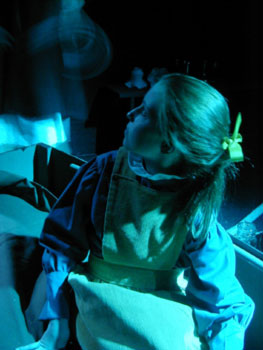
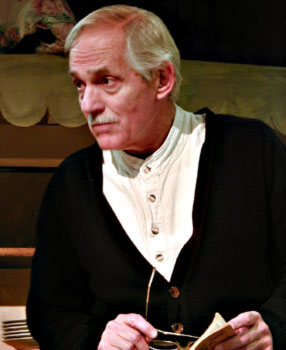
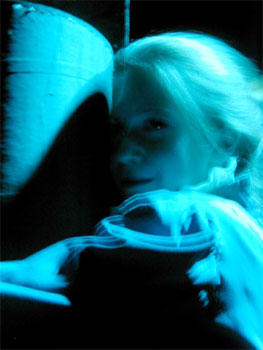
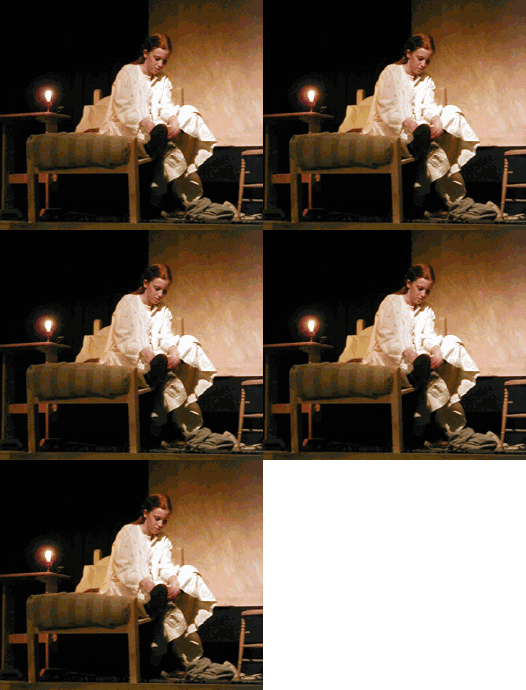
from The Waldo Independent, Page 26, December 13, 2001:
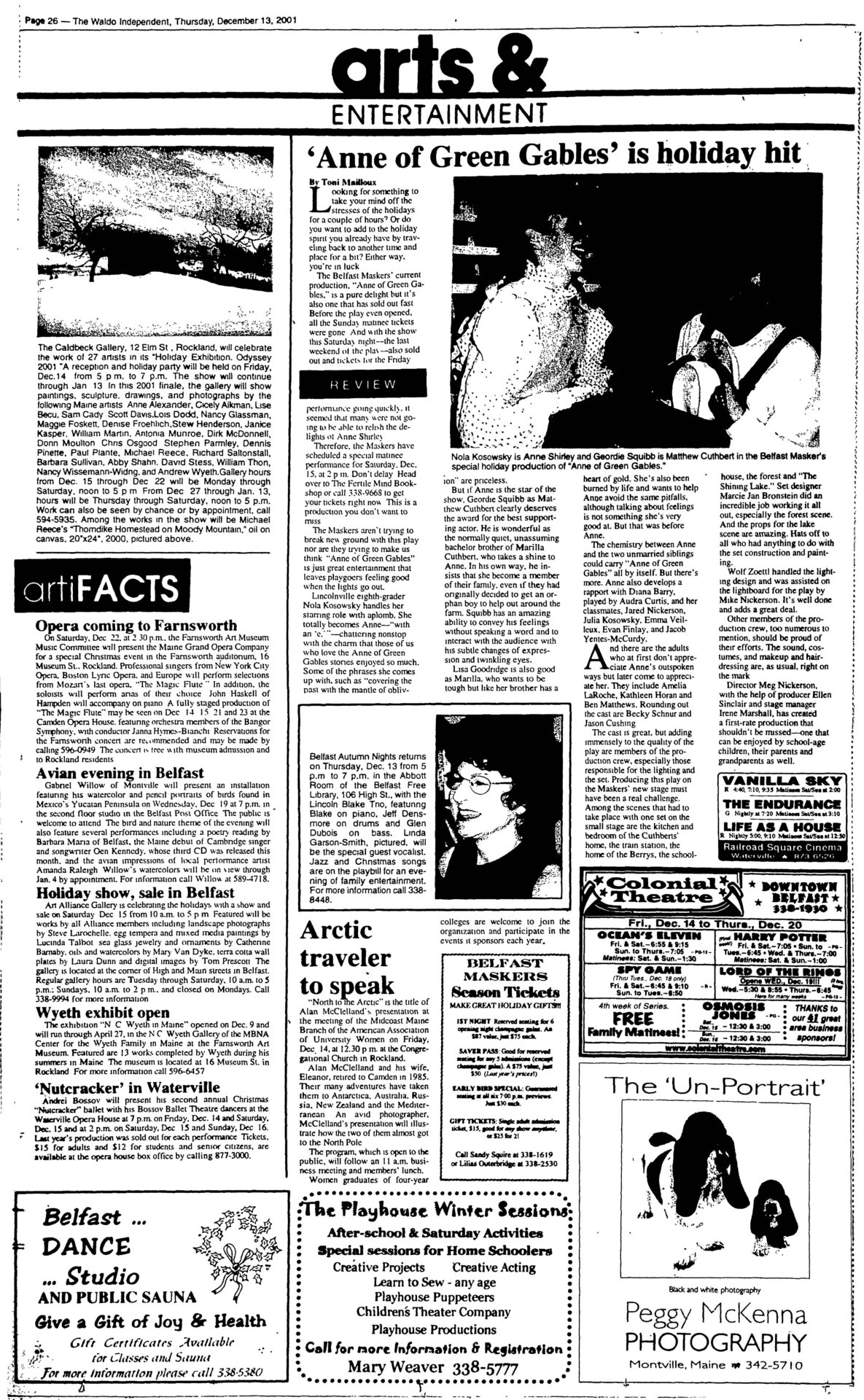
“‘Anne of Green Gables’ is holiday hit
By Toni Mailloux
Looking for something to take your mind off the stresses of the holidays for a couple of hours? Or do you want to add to the holiday spirit you already have by traveling back to another time and place for a bit? Either way, you’re in luck. The Belfast Maskers’ current production, “Anne of Green Gables,” is a pure delight but it’s also one that has sold out fast. Before the play even opened, all the Sunday matinee tickets were gone. And with the show this Saturday night — the last weekend of the play — also sold out and tickets for the Friday performance going quickly, it seemed that many were not going to be able to relish the delights of Anne Shirley.
Therefore, the Maskers have scheduled a special matinee performance for Saturday, Dec. 15, at 2 p.m. Don’t delay! Head over to The Fertile Mind Bookshop or call 338-9668 to get your tickets right now. This is a production you don’t want to miss.
The Maskers aren’t trying to break new ground with this play nor are they trying to make us think “Anne of Green Gables” is just great entertainment that leaves playgoers feeling good when the lights go out.
Lincolnville eighth-grader Nola Kosowsky handles her starring role with aplomb. She totally becomes Anne — “with an ‘e.’” — chattering nonstop with the charm that those of us who love the Anne of Green Gables story enjoyed so much. Some of the phrases she comes up with, such as “covering the past with the mantle of oblivion” are priceless.
But if Anne is the star of the show, Geordie Squibb as Matthew Cuthbert clearly deserves the award for the best supporting actor. He is wonderful as the normally quiet, unassuming bachelor brother of Marilla Cuthbert, who takes a shine to Anne. In his own way, he insists that she become a member of their family, even if they had originally decided to get an orphan boy to help out around the farm. Squibb has an amazing ability to convey his feelings without speaking a word and to interact with the audience with his subtle changes of expression and twinkling eyes.
Lisa Goodridge is also good as Marilla, who wants to be tough but like her brother has a heart of gold. She’s also been burned by life and wants to help Anne avoid the same pitfalls, although talking about feelings is not something she’s very good at. But that was before Anne.
The chemistry between Anne and the two unmarried siblings could carry “Anne of Green Gables” all by itself. But there’s more. Anne also develops a rapport with Diana Barry, played by Audra Curtis, and her classmates, Jared Nickerson, Julia Kosowsky, Emma Veilleux, Evan Finlay, and Jacob Yentes-McCurdy.
And there are the adults who at first don’t appreciate Anne’s outspoken ways but later come to appreciate her. They include Amelia LaRoche, Kathleen Horan and Ben Matthews. Rounding out the cast are Becky Schnur and Jason Cushing.
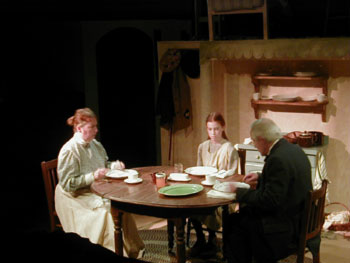
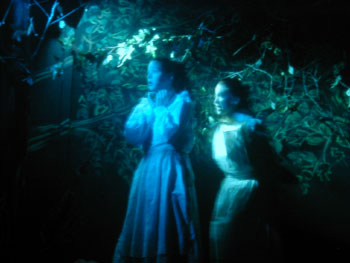
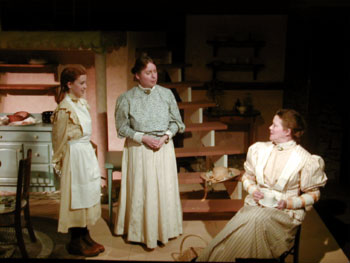
The cast is great, but adding immensely to the quality of the play are members of the production crew, especially those responsible for the lighting and the set. Producing this play on the Maskers’ new stage must have been a real challenge. Among the scenes that had to take place with one set on the small stage are the kitchen and bedroom of the Cuthberts’ home, the train station, the home of the Berrys, the schoolhouse, the forest and “The Shining Lake.” Set designer Marcie Jan Bronstein did an incredible job working it all out, especially the forest scene. And the props for the lake scene are amazing. Hats off to all who had anything to do with the set construction and painting.
Wolf Zoettl handled the lighting design and was assisted on the lightboard for the play by Mike Nickerson. It’s well done and adds a great deal.
Other members of the production crew, too numerous to mention, should be proud of their efforts. The sound, costumes, and makeup and hairdressing are, as usual, right on the mark.
Director Meg Nickerson, with the help of producer Ellen Sinclair and stage manager Irene Marshall, has created a first-rate production that shouldn’t be missed—one that can be enjoyed by school-age children, their parents and grandparents as well.


STEPPIN' OUT
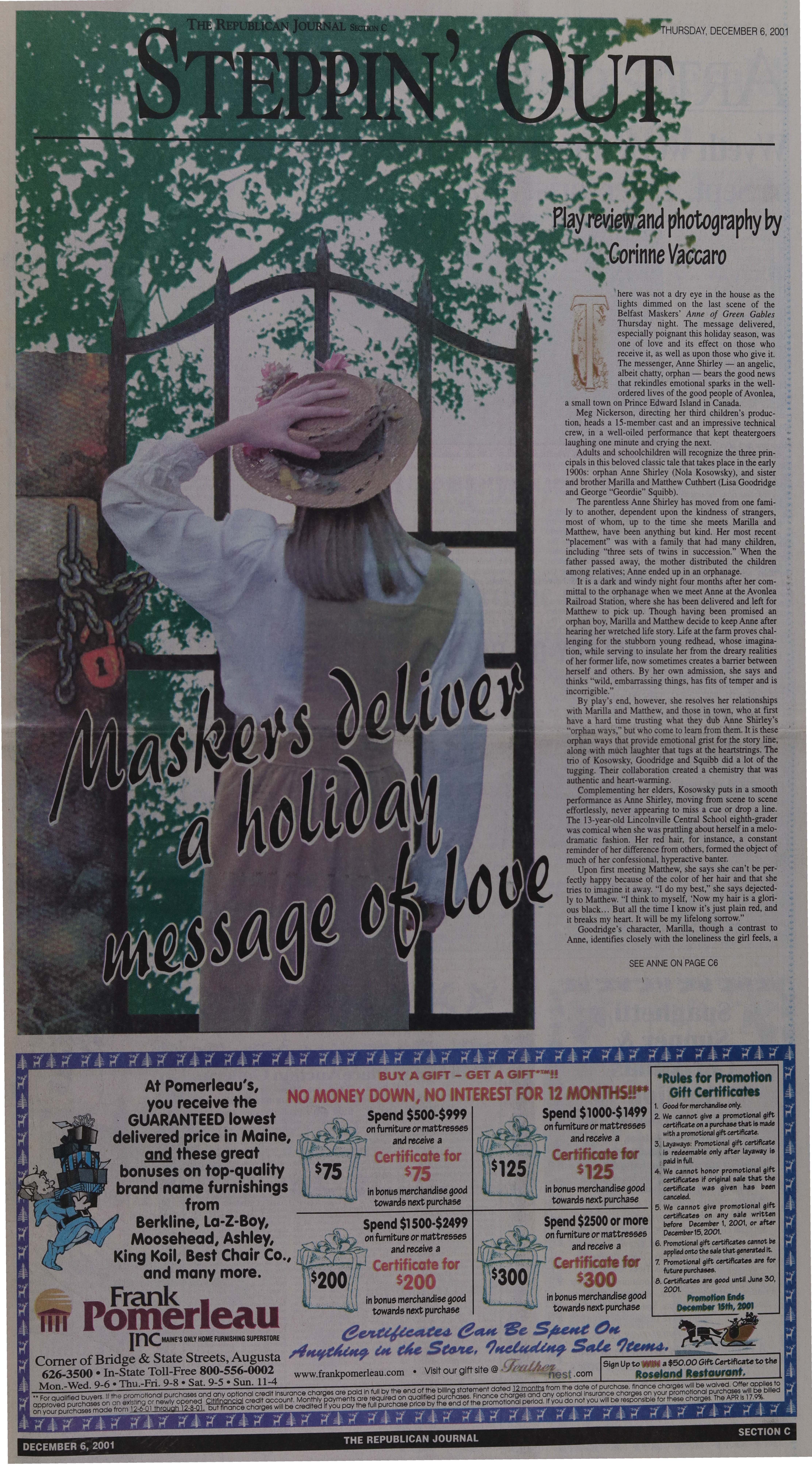
Play review and photography by Corinne Vaccaro
Republican Journal – Seite C5/C6 (Donnerstag, 6. Dezember 2001, Seite 27)
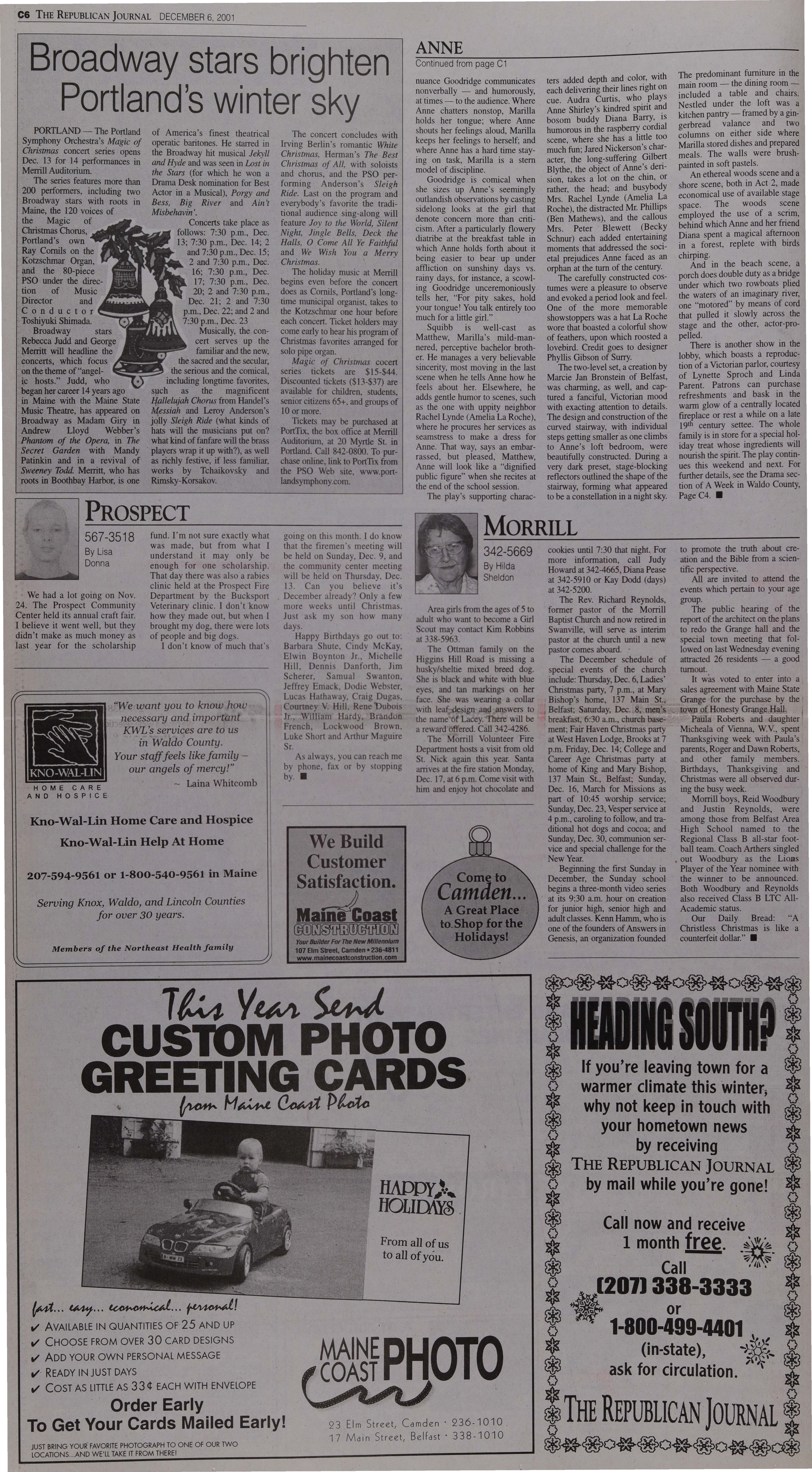
There was not a dry eye in the house as the lights dimmed on the last scene of the Belfast Maskers’ Anne of Green Gables Thursday night. The message delivered, especially poignant this holiday season, was one of love and its effect on those who receive it, as well as upon those who give it. The messenger, Anne Shirley — an angelic, albeit chatty, orphan — bears the good news that rekindles emotional sparks in the well-ordered lives of the good people of Avonlea, a small town on Prince Edward Island in Canada. Meg Nickerson, directing her third children’s production, heads a 15-member cast and an impressive technical crew, in a well-oiled performance that kept theatergoers laughing one minute and crying the next.
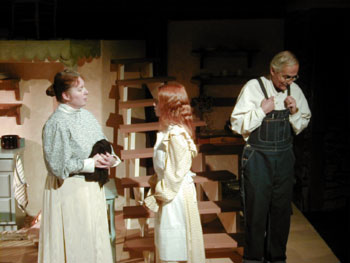
Adults and schoolchildren will recognize the three principals in this beloved classic tale that takes place in the early 1900s: orphan Anne Shirley (Nola Kosowsky), and sister and brother Marilla and Matthew Cuthbert (Lisa Goodridge and George “Geordie” Squibb).
The parentless Anne Shirley has moved from one family to another, dependent upon the kindness of strangers, most of whom, up to the time she meets Marilla and Matthew, have been anything but kind. Her most recent placement was with a family that had many children, including “three sets of twins in succession.” When the father passed away, the mother distributed the children among relatives; Anne ended up in an orphanage.
It is a dark and windy night four months after her committal to the orphanage when we meet Anne at the Avonlea Railroad Station, where she has been delivered and left for Matthew to pick up. Though having been promised an orphan boy, Marilla and Matthew decide to keep Anne after hearing her wretched life story. Life at the farm proves challenging for the stubborn young redhead, whose imagination, while serving to insulate her from the dreary realities of her former life, now sometimes creates a barrier between herself and others. By her own admission, she says and thinks “wild, embarrassing things, has fits of temper and is incorrigible.”
By play’s end, however, she resolves her relationships with Marilla and Matthew, and those in town, who at first have a hard time trusting what they dub Anne Shirley’s “orphan ways,” but who come to learn from them. It is these orphan ways that provide emotional grist for the story line, along with much laughter that tugs at the heartstrings. The trio of Kosowsky, Goodridge and Squibb did a lot of the tugging. Their collaboration created a chemistry that was authentic and heart-warming.
Complementing her elders, Kosowsky puts in a smooth performance as Anne Shirley, moving from scene to scene effortlessly, never appearing to miss a cue or drop a line. The 13-year-old Lincolnville Central School eighth-grader was comical when she was prattling about herself in a melodramatic fashion. Her red hair, for instance, a constant reminder of her difference from others, formed the object of much of her confessional, hyperactive banter. Upon first meeting Matthew, she says she can’t be perfectly happy because of the color of her hair and that she tries to imagine it away. “I do my best,” she says dejectedly to Matthew. “I think to myself, ‘Now my hair is a glorious black... But all the time I know it’s just plain red, and it breaks my heart. It will be my lifelong sorrow.”
Goodridge’s character, Marilla, though a contrast to Anne, identifies closely with the loneliness the girl feels, a nuance Goodridge communicates nonverbally — and humorously, at times — to the audience. Where Anne chatters nonstop, Marilla holds her tongue; where Anne shouts her feelings aloud, Marilla keeps her feelings to herself; and where Anne has a hard time staying on task, Marilla is a stern model of discipline. Goodridge is comical when she sizes up Anne’s seemingly outlandish observations by casting sidelong looks at the girl that denote concern more than criticism. After a particularly flowery diatribe at the breakfast table in which Anne holds forth about it being easier to bear up under affliction on sunshiny days vs. rainy days, for instance, a scowling Goodridge unceremoniously tells her, “For pity sakes, hold your tongue! You talk entirely too much for a little girl.”
Squibb is well-cast as Matthew, Marilla’s mild-mannered, perceptive bachelor brother. He manages a very believable sincerity, most moving in the last scene when he tells Anne how he feels about her. Elsewhere, he adds gentle humor to scenes, such as the one with uppity neighbor Rachel Lynde (Amelia La Roche), where he procures her services as seamstress to make a dress for Anne. That way, says an embarrassed, but pleased, Matthew, Anne will look like a “dignified public figure” when she recites at the end of the school session.
The play’s supporting characters added depth and color, with each delivering their lines right on cue. Audra Curtis, who plays Anne Shirley’s kindred spirit and bosom buddy Diana Barry, is humorous in the raspberry cordial scene, where she has a little too much fun; Jared Nickerson’s character, the long-suffering Gilbert Blythe, the object of Anne’s derision, takes a lot on the chin, or rather, the head; and busybody Mrs. Rachel Lynde (Amelia La Roche), the distracted Mr. Phillips (Ben Matthews), and the callous Mrs. Peter Blewett (Becky Schnur) each added entertaining moments that addressed the societal prejudices Anne faced as an orphan at the turn of the century.
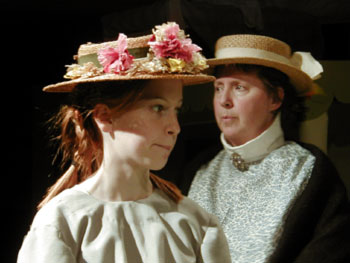
The carefully constructed costumes were a pleasure to observe and evoked a period look and feel. One of the more memorable showstoppers was a hat La Roche wore that boasted a colorful show of feathers, upon which roosted a lovebird. Credit goes to designer Phyllis Gibson of Surry.
The two-level set, a creation by Marcie Jan Bronstein of Belfast, was charming, as well, and captured a fanciful, Victorian mood with exacting attention to details. The design and construction of the curved stairway, with individual steps getting smaller as one climbs to Anne’s loft bedroom, were beautifully constructed. During a very dark preset, stage-blocking reflectors outlined the shape of the stairway, forming what appeared to be a constellation in a night sky. The predominant furniture in the main room — the dining room — included a table and chairs. Nestled under the loft was a kitchen pantry — framed by a gingerbread-valance and two columns on either side where Marilla stored dishes and prepared meals. The walls were brush-painted in soft pastels.
An ethereal woods scene and a shore scene, both in Act II, made economical use of available stage space. The woods scene employed the use of a scrim, behind which Anne and her friend Diana spent a magical afternoon in a forest, replete with birds chirping. In the beach scene, a porch does double duty as a bridge under which two rowboats plied the waters of an imaginary river, one “motored” by means of cord that pulled it slowly across the stage and the other, propelled.
There is another show in the lobby, which boasts a reproduction of a Victorian parlor, courtesy of Lynette Sproch and Linda Parent. Patrons can purchase refreshments and bask in the warm glow of a centrally located fireplace or rest a while on a late 19th-century settee. The whole family is in store for a special holiday treat whose ingredients will nourish the spirit. The play continues this weekend and next.