
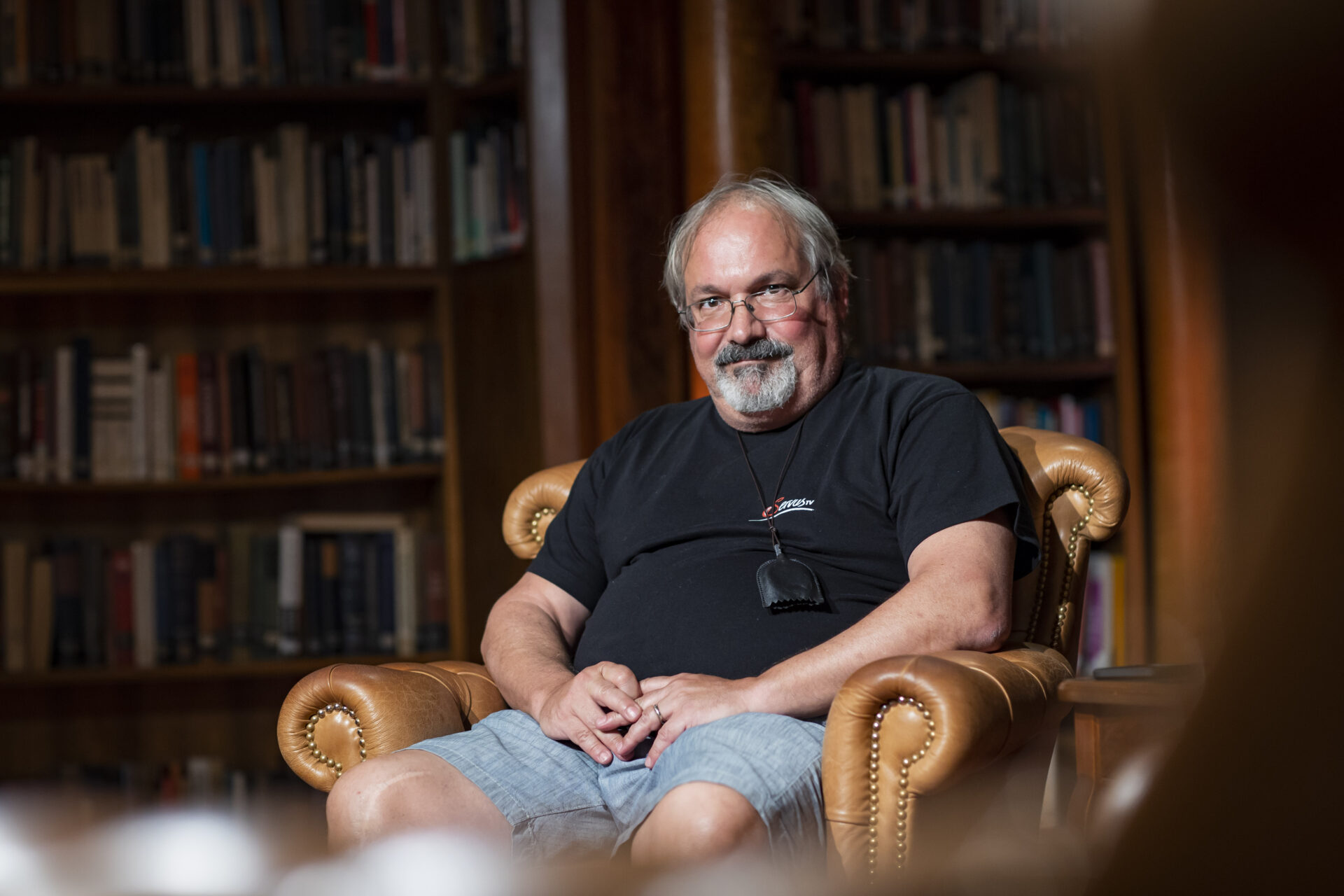
The host Ioan Holender invites artists, journalists, and creative individuals to discussions in the “Salzburger Festspieltalk”(ServusTV) in the library of Schloss Leopoldskron. Max Reinhardt, along with Hugo von Hofmannsthal and Richard Strauss, initiated the Salzburg Festival at Schloss Leopoldskron, officially commencing on August 22, 1920, with the performance of “Jedermann” on Salzburg’s Cathedral Square.
Max Reinhardt’s library exudes cultural significance and elegance, with tall shelves filled to the ceiling. Artfully decorated wood paneling adorns the walls, while antique furniture or desks transform the space into a hub for study and creativity. A hidden spiral staircase adds an extra touch of mystery and fascination to the room.
Schloss Leopoldskron, an impressive Baroque castle, is located on the outskirts of Salzburg, Austria. It was built in 1736 by Archbishop Leopold Anton Freiherr von Firmian and initially served as a residence, showcasing the grand Baroque design of that era.
In 1918, the renowned Austrian theater director and founder of the Salzburg Festival, Max Reinhardt, purchased the castle and initiated extensive renovations. Under his leadership, Schloss Leopoldskron became a center for cultural activities, artistic exchange, and intellectual discussions.
During the 1920s, the castle became a crucial meeting point for artists, writers, and intellectuals. Max Reinhardt organized numerous events that fostered creative dialogue, with one of the most significant being the founding of the Salzburg Festival in 1920, where the castle played a central role.
After Reinhardt’s death in 1943, the castle changed owners several times until it was eventually acquired by the American entrepreneur and heir to the Getty oil fortune, Howard Hughes. In the 1980s, Harvard University purchased the castle and established the “Harvard University Center for European Studies.”
Today, Schloss Leopoldskron functions as a hotel and event venue. Its impressive architecture, historical significance, and cultural heritage make it a crucial symbol of Salzburg’s rich history and the Salzburg Festival.